What the Boreholes Didn't Say: Managing the Ground That Rewrites Your Programme
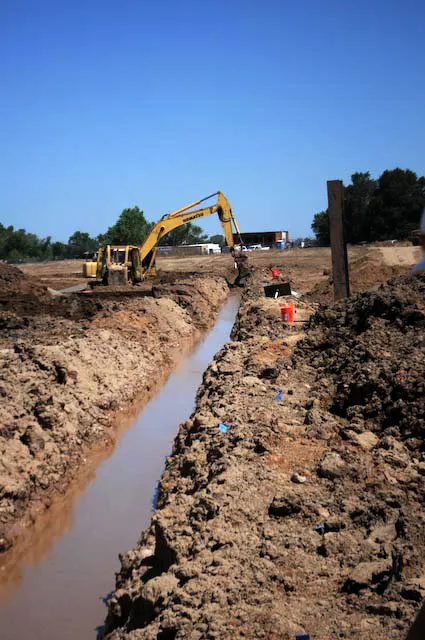
Photo: U.S. Army Corps of Engineers Sacramento District, Public domain, via Wikimedia Commons
There is a particular silence that falls over a site office when the machine operator radios in to say he has stopped digging. Not because he has finished — because he has found something. A slab of concrete where the survey said there would be clay. Water rising in the excavation faster than the pump can clear it. Brickwork, mortared and deliberate, three metres down where no structure was ever recorded.
For civil engineering contractors, these moments are not anomalies. They are a near-certainty on British sites, and how a client and contractor have prepared for them often determines whether a project finishes as a partnership or a dispute.
Britain Digs Its Own Surprises
This island has been industrialising for three centuries, and the record of what was buried along the way is patchy at best. Victorian engineers rarely surveyed their own foundations with posterity in mind. Mills, gasworks, collieries and tramways came and went, leaving footings, culverts, foundations and contamination that appear on no drawing held by any local authority.
Add to that the geology itself. Perched water tables sit above the impermeable layers that hold them, invisible until an excavation breaches the seal. Alluvial deposits along our rivers shift and soften. In the Midlands and the North, shallow mine workings from the eighteenth and nineteenth centuries remain unmapped across thousands of hectares.
The point is not that ground investigation is futile. It is that even a competent, well-specified investigation samples a fraction of the site, at points chosen before anyone has stood on it. The ground keeps some of its secrets regardless.
Three Vignettes from the Field
The unrecorded culvert. On a highways improvement scheme in the North West, a drainage excavation encountered a brick culvert carrying a watercourse that had been culverted — and then forgotten — sometime in the 1880s. No record existed. The programme lost five weeks while a diversion was designed, agreed with the environment regulator and constructed. The saving grace: the contract's compensation events machinery was used properly, the event was notified within days, and the cost was assessed on actual records rather than haggled into a lump sum.
The perched water table. On a school site in the Home Counties, two boreholes drilled in a dry February showed no groundwater. Excavations in the following October found water standing a metre below ground, held up by a lens of clay the investigation had missed. The piling mat turned to porridge. The lesson was not that the investigation was negligent — it was that seasonal timing matters, and that the contract needs to accommodate the difference between what was sampled and what exists.
The obstructions clause that worked. A brownfield redevelopment in Yorkshire had, unusually, a well-drafted ground risk clause. When foundations of a demolished chemical works appeared across a third of the footprint, the client and contractor worked through a pre-agreed schedule of rates for obstruction removal. No standstill, no threat of adjudication. The clause cost the client's legal team a day to draft and the project a fortnight, not six months.
Who Carries the Risk?
The allocation of ground risk is the single most contested issue in UK construction contracting, and the default positions could hardly differ more.
Under traditional forms such as NEC4 and JCT, the employer generally retains the risk of unforeseen physical conditions — the contractor is compensated for events a reasonably experienced contractor could not have anticipated. The test of what is 'unforeseeable' is judged against the site information provided, which places a heavy burden on the client to investigate competently and share everything found.
Design-and-build and fixed-price contracts frequently push the risk the other way. A contractor pricing a lump sum absorbs the cost of whatever lies beneath — and prices that absorption into every line. The client pays for the risk whether it materialises or not, and pays again in the behavioural consequences: conservative designs, defensive pricing, and a contractor whose first instinct on finding a problem is to protect a position rather than solve one.
Neither approach is wrong in all circumstances. But clients should understand that a bargain price on a poorly investigated site is not a saving. It is a deferred payment with interest.
A Checklist for Clients Before Contract Award
If you are commissioning infrastructure or a major building, the following steps cost a fraction of what ground disputes cost:
- Investigate early, and investigate properly. A desk study and intrusive investigation — not just trial pits — should be complete before tender. Budget 1–2% of project value; disputes routinely cost ten times that.
- Match the investigation to the works. Boreholes at foundation positions, not at convenient gateways. Depth to the proposed formation level, not to a nominal six metres.
- Consider the season. Groundwater readings taken in a dry summer may be meaningless by February. Where water is a plausible risk, install standpipes and monitor across months.
- Search the historical record thoroughly. Old Ordnance Survey editions, mining reports, the Coal Authority, and local archives routinely reveal structures no modern record holds.
- Share everything. Every report, every anomaly, every borehole log — in the tender pack, not discovered in a drawer afterwards. Concealment destroys the contractual protection the client thought it had.
- Draft the ground clause deliberately. Decide who carries which risk, define what counts as an unforeseeable condition, agree rates for obstruction removal in advance, and make sure the notification procedure is workable on a live site.
- Keep the site records live. Photographs, daily digs records and machine operators' notes are the evidence base if a compensation event follows.
The Ground Rewards Preparation
No investigation eliminates ground risk, and no contract clause makes a culvert disappear. But the difference between a well-run project and a bitter one is rarely the size of the surprise. It is whether the client investigated with genuine intent, shared what it knew, and drafted for the day the excavator stops.
At Civmec UK we would rather price a well-investigated site honestly than a poorly investigated one cheaply. The first is a partnership. The second is a bet — and the ground usually wins.