The Workforce Question Every Public-Sector Client Should Ask Before Signing a Contract
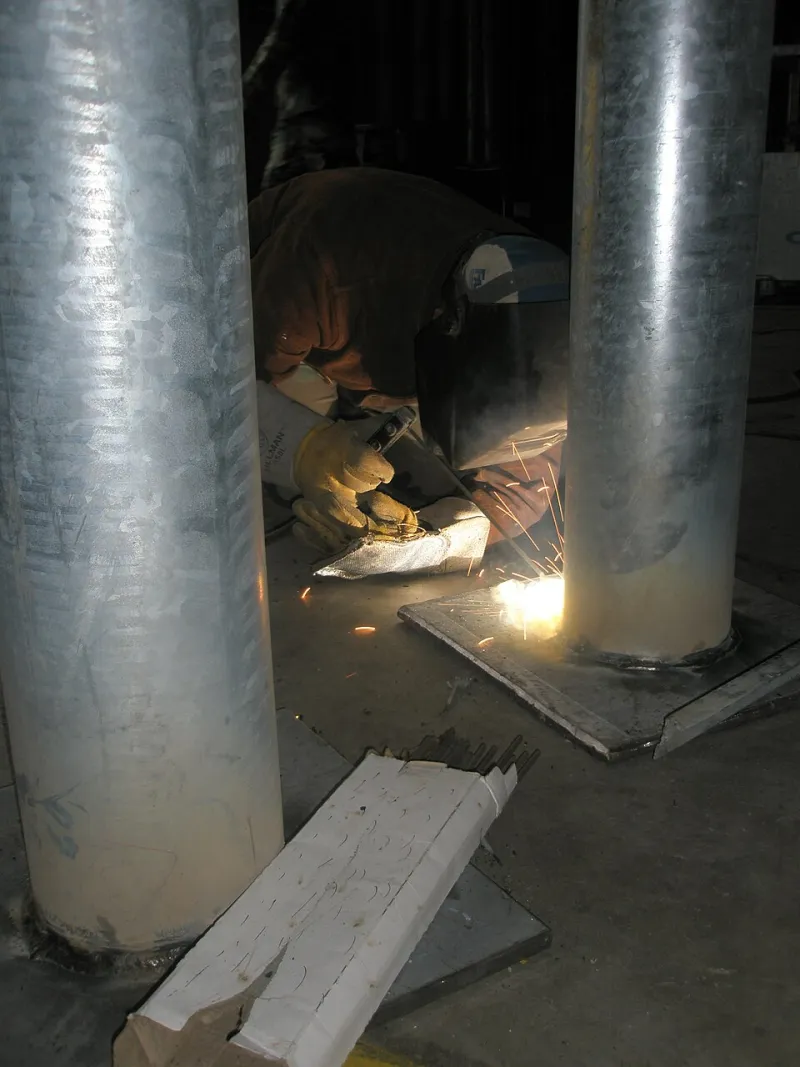
Photo: U.S. Navy photo by Builder Constructionman Apprentice Jacob Kusay, Public domain, via Wikimedia Commons
Government commitments on energy, transport and flood resilience have created an infrastructure pipeline of historic scale. Yet the binding constraint on delivery is no longer funding or consent — it is people. The Construction Industry Training Board has consistently warned that the sector needs tens of thousands of additional workers each year to meet projected demand, and the shortfalls are concentrated in precisely the trades that infrastructure projects depend upon.
For public-sector procurement teams, this creates a practical problem: how do you distinguish between a contractor with genuine workforce capability and one whose resourcing plan is optimistic fiction? It starts with understanding where the gaps actually are.
1. Coded Welders and Fabricators
Welding sits at the heart of mechanical contracting — structural steelwork, pipework fabrications, marine and industrial installations. Coded welders, particularly those qualified to exacting standards for critical applications, are in chronically short supply. An ageing workforce has not been fully replaced, and the specialist nature of the qualification means gaps cannot be closed quickly.
Contractors with in-house fabrication facilities and structured apprenticeship pipelines are better placed to guarantee capacity than those relying entirely on agency labour at the point of need.
2. Mechanical Project and Package Managers
The coordination of mechanical scopes — interfaces with civils, sequencing of installations, management of specialist subcontractors — demands experience that takes years to accumulate. As major programmes compete for the same individuals, salary inflation alone cannot conjure competence. Clients should look for evidence of depth in a contractor's management bench, not reliance on one or two key names.
3. Pipefitters and Mechanical Installers
Process, energy and water sector projects all draw on the same finite pool of skilled pipefitters. With energy infrastructure and water company AMP programmes running concurrently, competition is intense. Workforce resilience here means established supply chains, training partnerships and, ideally, direct employment rather than a fragile web of subcontractors.
4. Digital and Engineering Technicians
Building information modelling, digital handover documentation and off-site design coordination are now standard expectations on public contracts. Technicians who bridge the gap between design software and site practice are scarce. Contractors investing in digital capability signal both modernity and a reduced dependence on external consultants.
5. Site Supervision with Sector Knowledge
Generic site management is not enough on infrastructure works. Supervisors who understand the specific demands of marine environments, live operational sites or safety-critical installations are the difference between smooth delivery and costly disruption. This is perhaps the least visible skills gap — and the hardest to verify from a tender submission alone.
What Procurement Teams Should Ask
Tender evaluation offers a genuine opportunity to test workforce resilience, and the questions need not be complicated:
- What proportion of your delivery workforce is directly employed? Direct employment correlates strongly with retention, training investment and continuity.
- How many apprentices are currently in your pipeline, and at what stage? Real apprenticeship numbers, verifiable over several years, indicate commitment rather than tokenism.
- Can you evidence succession depth for key roles? A named individual on a CV is not a resourcing plan.
- What partnerships do you hold with colleges or training providers? Local training links also speak to the social value commitments increasingly weighted in public procurement.
A Shared Interest
It is tempting to view skills shortages as the industry's problem to solve. In practice, clients and contractors share the risk. A project awarded to a contractor who cannot resource it fails everyone: the client, the community awaiting the asset, and the wider credibility of public procurement.
The contractors most likely to deliver Britain's infrastructure pipeline are those treating workforce development as a core capability rather than an administrative burden — investing in apprenticeships, retaining skills through direct employment and building training relationships that outlast any single contract. Procurement teams who know how to recognise that investment, and weight it appropriately in their evaluations, will be better placed to choose partners capable of turning pipeline into delivered infrastructure.