Taking It Down Properly: The Engineering Discipline Behind Britain's Great Dismantling Wave
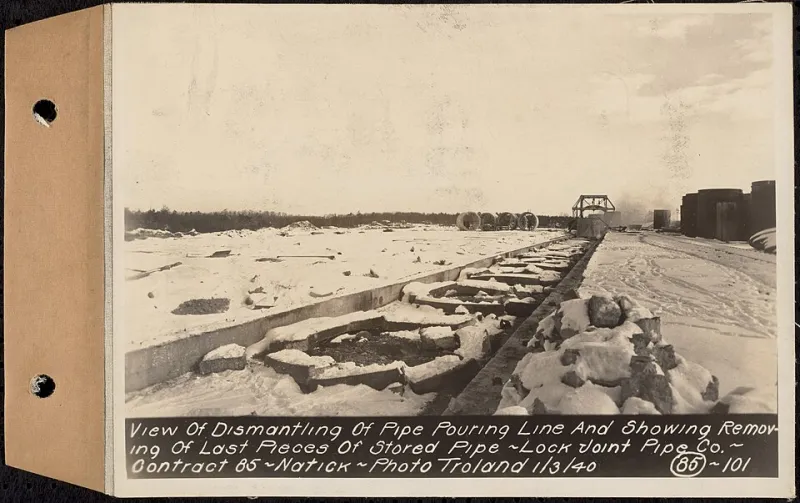
Photo: Massachusetts. Metropolitan District Water Supply Commission, Troland, Edwin Parker, 1914-2004, Public domain, via Wikimedia Commons
For most of the twentieth century, Britain was a country that built. Cooling towers rose over the Trent valley, gas holders framed the skylines of almost every industrial town, and process plants hummed along our estuaries. Now a remarkable share of that inheritance is reaching the end of its design life at once — and the industry is discovering that taking a structure down safely is every bit as intellectually demanding as putting one up.
A Nation of Structures Running Out of Road
The scale is easy to underestimate. Coal-fired generation has all but ceased, leaving stations from Ratcliffe-on-Soar to Fiddlers Ferry needing careful, multi-year dismantling. Gas holders — many listed, many more simply tired — are being cleared from sites that councils want back for housing. Petrochemical and process facilities installed in the 1960s and 1970s are past the point where continued operation is economic.
Each of these assets was engineered with enormous care. The mistake, repeatedly made, is assuming their removal requires less.
Reverse Engineering, In Earnest
A decommissioning engineer works with an unfamiliar disadvantage: the drawings are often incomplete, the steelwork has been modified by decades of maintenance nobody documented, and the structure may be weaker than it looks rather than stronger. Before a single bolt is cut, someone must establish how the structure actually stands up today — not how it was designed to.
That means temporary works design that rivals anything on a construction project. It means load monitoring, structural surveys, and a sequence planned so the building remains stable at every stage of its partial existence. The iconic controlled collapses make the news, but they represent perhaps five per cent of the work. The other ninety-five per cent is methodical, piece-by-piece engineering conducted with cranes, rigging and an intimate knowledge of what happens when a load path disappears.
The Skills Nobody Trained For
The workforce question is acute. Dismantling draws on a blend of disciplines — structural engineering, heavy rigging, hazardous materials survey, environmental management — that rarely sits neatly within a single trade. Many of the most experienced practitioners learned on the nuclear estate, where decommissioning has been a standing discipline for decades, and their numbers are thinning.
At Civmec UK we see this first-hand: the mechanical and structural competencies that serve fabrication and installation so well translate directly to dismantling, but only when paired with specialists who understand contamination, asbestos legacy materials and the idiosyncrasies of old plant.
The Budget Problem
Here is the uncomfortable part. Public-sector clients routinely allocate generous contingency for construction and almost nothing for end-of-life removal. Decommissioning is treated as a land-transaction afterthought, bolted onto a sale agreement, rather than as a project with its own engineering risks.
The consequences are predictable: programmes that slip, budgets that escalate, and safety margins squeezed by commercial pressure. The remedy is straightforward and unglamorous — survey early, cost honestly, and procure decommissioning with the same tender discipline applied to any new build. Whole-life thinking, increasingly standard in procurement guidance, must include the cost of undoing what is built.
An Opportunity Disguised as a Chore
Handled well, decommissioning is not merely an expense. It recovers land for housing and industry, recycles thousands of tonnes of steel back into the supply chain, and builds a domestic skills base the country will need for decades as the energy transition retires yet more twentieth-century plant.
Britain built its industrial heritage with precision and integrity. Taking it down deserves nothing less.