What the Machinery on Our Estuaries Says About Us
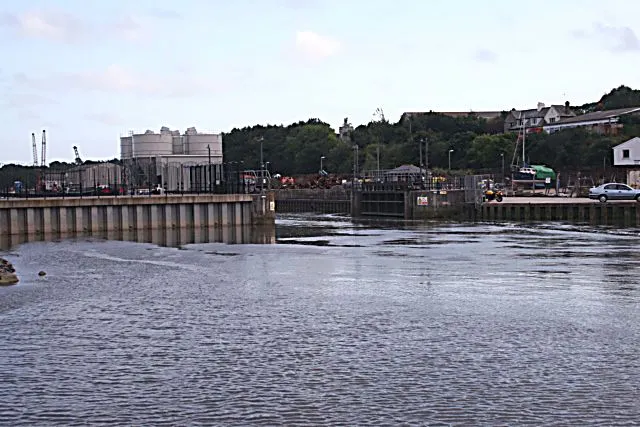
Photo: Fred James, CC BY-SA 2.0, via Wikimedia Commons
Stand on the banks of the Severn estuary at low tide and you are looking at one of the largest tidal ranges on the planet — a wall of water that will return, twice daily, whether we have prepared for it or not. The machinery we have chosen to place between that water and our communities says more about Britain than any policy paper. It records, in steel and hydraulics and concrete, exactly what we were willing to invest in when nobody was watching.
Machinery as a Historical Document
Every pumping station, every sluice gate, every barrier drive mechanism carries a date stamp of national intent. The post-war decades produced robust, over-engineered plant — machines built with generous factors of safety because the engineers specifying them had lived through failure and wanted margin. Walk through some of the older pumping installations on our eastern estuaries and you will find motors still turning after fifty years of saline service, not because they were lucky, but because somebody in 1968 decided that reliability was worth the extra tonnage of steel.
Then compare this with the installation booms of the 1980s and 1990s. Capital budgets tightened. Specifications were value-engineered. The machinery that resulted is not necessarily poor — but it is leaner, and its lean-ness reflects a public spending philosophy that prioritised the tender price over the whole-life ledger. We have written about that philosophy before in the context of contract awards; here, the consequences are bolted together and standing in the tide.
The Continental Contrast
It is instructive to look at what our near neighbours were doing in the same decades. The Dutch, facing the same North Sea, took a different view of the arithmetic. The great Delta Works were not conceived as flood defences in the narrow sense; they were conceived as a permanent national commitment, with mechanical plant specified for century-long service lives and maintenance budgets treated as non-negotiable rather than discretionary. The moving gates and hydraulic systems there were designed on the assumption that replacement would be a generational event, planned decades in advance.
In Britain, the comparable installations — and there are genuinely impressive ones, particularly along the Thames — were often delivered with equal engineering skill but embedded in a different fiscal culture. Maintenance here has historically competed with other priorities each budget round. The result is a patchwork: some plant meticulously kept, some quietly run to failure, and the difference between the two is usually a matter of local authority budgets rather than engineering judgement.
What Underinvestment Actually Looks Like
Underinvestment in flood-defence machinery is rarely dramatic. It does not announce itself with a collapse. It looks like a pumping station where two of four pumps are serviceable going into winter. It looks like gate drives awaiting parts that have been on order for months because the original manufacturer no longer exists. It looks like skilled operators retained through goodwill rather than proper establishment, because the maintenance line was the easiest one to trim.
The Environment Agency has been candid in recent years about the maintenance backlog across its asset base. This is not a criticism of the engineers within these organisations — it is a structural observation. When mechanical plant is funded reactively, the nation effectively chooses a strategy of managed risk, and it should do so with its eyes open.
The Next Fifty Years Are Being Specified Now
The Severn estuary will demand decisions in the coming decades, whether through enhanced defences, managed adaptation, or major barrier infrastructure. Whatever route is taken, the mechanical engineering choices made at the specification stage will outlast every person in the room. Drive systems, gate materials, corrosion protection regimes, spare-part strategies — these decisions will define maintenance costs for half a century.
Our view, formed across decades of heavy fabrication and mechanical installation, is straightforward: specify for the fifty-year operator, not the five-year budget. That means generous corrosion allowances, standardised components where possible, maintenance access designed in from the first drawing, and contractual frameworks that reward durability rather than penalising it through lowest-price selection.
A Question of Priorities, Not Capability
Britain possesses the engineering capability to build estuary machinery that will still be running in 2125. British workshops can fabricate it, British engineers can specify it, and British firms can install and maintain it. The constraint has never been capability. It has been the willingness of the funding system to pay for margin — for the extra steel, the better coating, the simpler design that a technician can repair in the rain at three in the morning.
The quiet machines on our estuaries will still be there long after the budget rounds that shaped them are forgotten. What we build next should be chosen so that, a century hence, an engineer looking at our work reaches the same verdict the post-war generation earned: they meant it to last.