Beneath the First Spadeful: The Unseen Battle to Make Old Industrial Ground Buildable
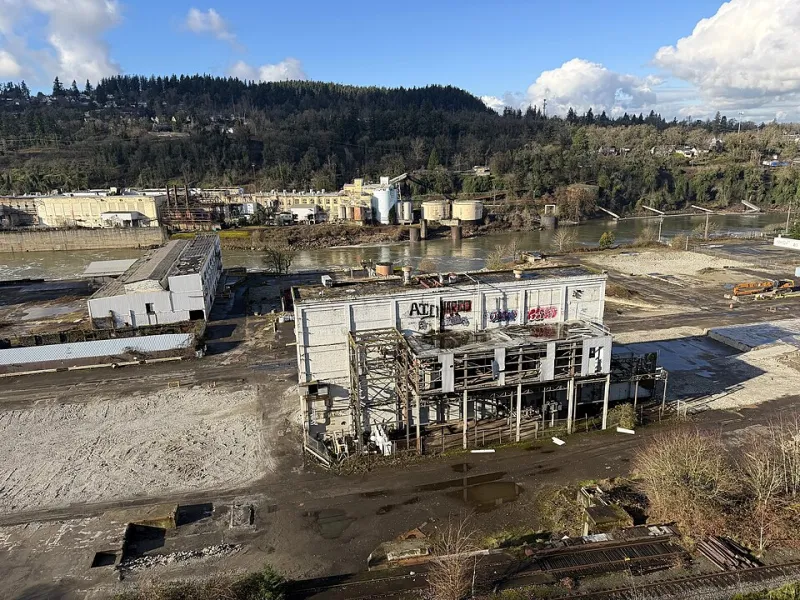
Photo: PortlandAppraisalBlog, CC BY-SA 4.0, via Wikimedia Commons
The Land Britain Already Has
Drive through any of Britain's older industrial regions — the Black Country, Teesside, the lower Don Valley — and you will pass derelict acres that were once the engine rooms of the economy. Gasworks, coking plants, smelting works, municipal landfills. To a passing observer, they look like waste. To a developer, they represent something more valuable: land with existing transport links, grid connections and, increasingly, planning policy on their side.
The National Planning Policy Framework pushes hard for brownfield-first development, and rightly so. But the policy enthusiasm glosses over a hard truth. The ground beneath a former gasworks is not simply empty space waiting for a foundation slab. It is a chemical and geotechnical puzzle, and the cost of solving it frequently determines whether a scheme is built at all.
What the Surveys Actually Find
Remediation begins long before any plant arrives on site, with a phased investigation that most members of the public never hear about. Desk studies first: historic Ordnance Survey maps, mining records, trade directories, geological data. A site that hosted a tar distillery in 1902 will carry a different risk profile from one that was a brickworks.
Then comes the intrusive investigation. Boreholes and trial pits are sunk across the site, and the samples tell a story in parts per million. Former gasworks typically leave behind coal tars, cyanides, phenols and sulphates. Foundries can leave spent foundry sand laced with heavy metals. Landfills generate methane and carbon dioxide that will migrate through permeable ground for decades after closure.
The survey phase matters because it converts unknown risk into quantified cost. A remediation strategy written on incomplete data is an invitation to variation orders. Clients who trim the investigation budget to save money in the early stages almost invariably pay more later — a pattern anyone who has sat through a final account meeting will recognise.
Remediation Is Not One Method but a Portfolio of Them
There is no single fix for contaminated ground. The strategy for any given site is assembled from a menu, chosen on cost, timescale and the intended end use.
Dig and dispose remains the blunt instrument: excavate the contaminated material and haul it to a licensed landfill. It is fast and certain, but haulage and landfill gate fees have climbed sharply, and the volumes involved on a heavy industrial site can run to tens of thousands of cubic metres.
Stabilisation and solidification treats contamination in situ, binding contaminants into a cementitious matrix so they cannot leach. It avoids the lorry movements and keeps material out of landfill, which increasingly matters both commercially and for planning conditions on carbon.
Gas protection addresses the landfill legacy differently. Rather than removing the hazard, the design manages it: gas membranes beneath floor slabs, venting layers, verification testing at every stage of construction.
Containment accepts that some contamination will stay put, capped and cut off from pathways by engineered barriers. It is often the pragmatic answer where a shallow cap-formation layer can serve as the working platform for the structures above.
The Piling Problem Nobody Budgets For
Here is where remediation and structural engineering collide, and where many schemes stumble. Heavy industrial facilities need deep foundations. The ground that made the site cheap to buy — made ground, fill, old foundations, buried obstructions — is precisely the ground that makes piling difficult.
Driven piles struggle through obstructions: old concrete bases, buried rails, timber from demolished structures. Bored piles cope better but generate arisings that may themselves be classified as contaminated waste. And in certain ground conditions, particularly those with sulphate-bearing soils or made ground with reactive materials, the concrete mix specification for the piles becomes a design issue in its own right.
There is also the question of what piles do to contaminants. Penetrating a low-permeability cap or driving through a contaminated stratum into a clean aquifer below can create a pollution pathway. The remediation strategy and the foundation design cannot be developed in isolation; they are the same problem viewed from two directions.
Why the Cost Line Decides Everything
Ask anyone who has taken a brownfield industrial scheme through funding approval and they will tell you the same thing: the abnormal costs of remediation and foundations are the swing factor. A greenfield site with clean granular soil might support a straightforward pad foundation design. The equivalent brownfield site might carry a remediation bill in the millions before a single column is erected.
That is not an argument against brownfield development. It is an argument for honest early-stage engineering. The schemes that succeed are the ones where clients commission proper ground investigation, engage geotechnical and remediation specialists before the funding submission rather than after, and price the risk realistically. The schemes that fail — or worse, limp through with underfunded ground works and surface later as defects — are the ones that treated the ground as a detail to be resolved after contract award.
The Work Nobody Sees
There is a ribbon-cutting photograph at the end of every major infrastructure project: dignitaries, hard hats, a gleaming facility. Nobody photographs the remediation. The soil mixing rigs, the gas membrane verification, the pile mat that allowed a rig to work safely over made ground — all of it buried, literally, beneath the finished structure.
But that is where projects are genuinely won or lost. Britain has committed to reusing its industrial legacy, and the engineering that makes dormant land work again deserves rather more credit than it gets. The ground remembers what was done to it. Good practice ensures it remembers favourably.