Signed Off in the Workshop, Felt on Site for Decades: Fabrication Choices That Outlast Everyone in the Room
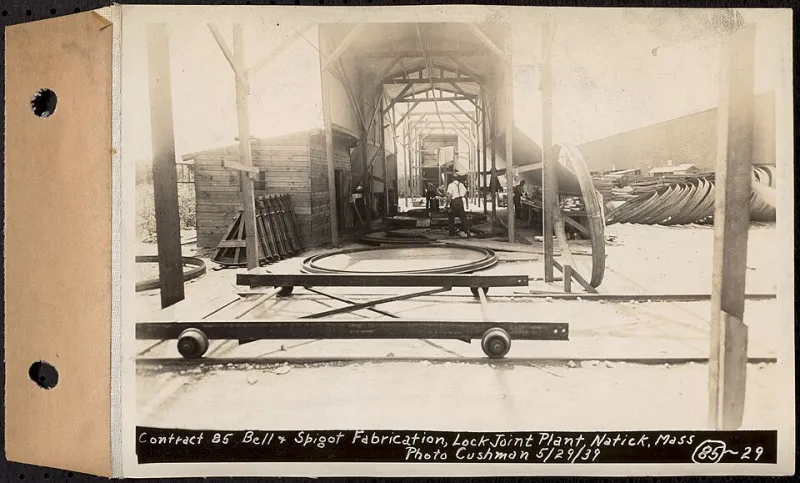
Photo: Massachusetts. Metropolitan District Water Supply Commission, Cushman, Allerton R., 1907-1999, Public domain, via Wikimedia Commons
The Contract Covers the Steel. Does It Cover the Judgement?
When procurement teams evaluate a fabrication package, the natural instinct is to focus on what can be verified: material certificates, dimensional tolerances, weld inspection records, the final pre-delivery survey. All of that matters. But the decisions with the longest consequences are often the ones that never appear on an inspection checklist — the quiet choices a fabricator makes in the yard, months before anyone sees the structure. Here are five of them, and why each deserves a line in your scrutiny.
1. Weld Sequencing: The Invisible Hand on Distortion
Weld a long joint from one end and the heat pulls the steel towards it as it cools. Weld it properly, with a balanced sequence and backstepping technique, and the component stays true. Get it wrong and the distortion shows up later as misalignment on site, forced fit-up, and a structure carrying locked-in stresses it was never designed for.
The fix costs nothing if it is planned at the workshop stage: split the welds, control the heat input, check between passes. The fix costs a fortune if it is discovered during erection. Ask prospective fabricators how they sequence welds on long assemblies and whether distortion is modelled or merely hoped away. The answer will tell you a great deal about the yard.
2. Coating Specification: Where the Penny-Pinching Shows Up in Year Eight
Protective coatings are routinely value-engineered, and the consequences are almost always deferred past the point where anyone connects cause and effect. A single-coat system instead of a multi-coat specification, or a blast profile that falls short of the standard, might save a few thousand pounds in the yard. It will cost a scaffold, an access strategy and a paint contract within a decade, in conditions far less forgiving than a workshop.
The specification itself is only half the story. Surface preparation — the abrasive blasting and the window between blast and first coat — is where coating systems are actually won or lost, and it is invisible once covered. Insist on hold points for blast inspection, and check that ambient condition monitoring is genuinely recorded rather than backfilled.
3. Access for Future Maintenance: Designing for the Second Visit
Nobody inspects a structure with the enthusiasm of the person who will have to maintain it. Yet fabrication drawings are routinely produced without anyone asking the obvious question: how will this be accessed in fifteen years for inspection, recoating or bolt replacement?
The answers differ by structure. Additional lifting lugs left in place. Bolted rather than welded connections at points where future replacement is foreseeable. Localised access provisions agreed with the end client's maintenance team rather than assumed by the drawing office. None of it is expensive at fabrication stage. All of it is expensive — sometimes prohibitively so — when retrofitted from rope access or a temporary platform over water or live rail.
4. Fit-Up Quality: The Tolerance Stack Nobody Adds Up
Each individual tolerance in a fabrication can be within specification, and the assembly can still be a problem. A few millimetres here, a few there, and by the time a multi-component assembly arrives on site the accumulated error has to be absorbed somewhere — usually by the erection crew, with packers, force and language your contract manager would rather not hear.
Good yards manage fit-up actively: trial assemblies of critical interfaces, controlled tolerance stacking, honest reporting when a component drifts. Poor yards pass the problem down the line. The question for procurement is not whether the fabricator holds tolerances individually, but whether they manage them cumulatively.
5. Traceability Discipline: The Paper Trail You Will Need One Day
Every structural steelwork contract requires material traceability, and every fabricator will confirm they provide it. The difference between yards emerges years later, when a query arises — a weld defect found during in-service inspection, an insurance question after an incident, a modification needing original material grades — and someone has to reconstruct the history.
Yards with genuine traceability discipline can answer within days, from records that were kept properly because the system made it easy. Yards without it produce a scramble, and sometimes an answer that cannot be substantiated. When you audit a fabricator, pull a random weld record and trace it back to the plate certificate. The speed and confidence of the response is the audit result.
Workshop Quality Control Deserves a Seat at the Table
The common thread through all five is simple: the most consequential quality decisions in a structure's life are made where the client's inspection presence is thinnest. Site inspection catches what arrives wrong. Workshop surveillance — hold points, witness of first articles, periodic audits of the yard's own quality system — catches what would otherwise go wrong silently.
For public-sector and infrastructure clients, the commercial logic is unarguable. The marginal cost of workshop oversight is a rounding error against the cost of rectifying distortion, recoating prematurely or reconstructing traceability on a structure that must remain in service for half a century. Put the yard on the inspection schedule. The structure, and your budget, will both last longer for it.